A Lifetime of Musical Experience
My Musical Beginning
Since 1965, I have maintained a vibrant and enduring career as a professional accordionist, performing extensively throughout the Detroit metropolitan area. I was privileged to study with two distinguished teachers—Louis Faggio of Weaver’s Music (1956–1964) and George Cailotto of Cailotto Music (1964–1967).
The Knight Kats
My professional musical journey began during my senior year of high school at Allen Park High School (1965–1966), when I joined The Knight Kats, an established five-piece wedding band from Lincoln Park. I continued performing with the group throughout my college years, while also sharing my passion for the accordion by giving private lessons.
Early in 1967, two members left our band, Glenn Carins on saxophone and Rex Chadwell on bass and trombone, to form their own group. At that time, the band needed to replace our saxophonist but not to replace our bass player. I contacted my former band director at Allen Park High School for a recommendation. Mr. Mitchell provided the name and phone number of Ray Noga, a 1963 graduate and Vietnam veteran from Allen Park. Ray auditioned and quickly demonstrated his talent, earning his place in the band.
In 1968, the band underwent several pivotal changes. The first occurred when our drummer, Dale Bosetti, volunteered for the U.S. Army, leaving a critical gap in our band. We held several auditions to find a replacement, but none of the candidates could master the wide variety of rhythms required to perform music spanning the previous 50 years—a skill essential for a successful wedding band. Ray suggested we audition his friend Tom DeMartin, an excellent drummer who had recently returned from Vietnam and had experience playing in a band in Allen Park. After the audition, it quickly became clear that he was an exceptional musician, capable of handling all the diverse styles the band needed. Later that same year, we faced the challenge of replacing our saxophonist. Fortunately, we found Gary Baumia from Flat Rock, who turned out to be the finest saxophonist the band had ever had. These changes strengthened the band, ensuring that we could continue delivering the wide-ranging music our audiences loved.
Early in 1969, Tim Cartwright, leader of the band and a guitar teacher at a local music store, introduced me to an all-electric accordion known as the Sanovox. This innovative instrument looked and played like a traditional accordion but produced the rich, resonant sound of an organ. Incorporating the Sanovox dramatically transformed the band’s overall sound, especially the bass. It delivered the depth and presence of a stand-up bass, strengthening the low end and giving the group a fuller, more powerful musical foundation. The result was a bigger, more dynamic sound that set the band apart and expanded the possibilities of accordion performance.
Our band's founder and leader, Tim, decided to leave the band in 1969. He left to attend college and pursue a career in chiropractic. Fortunately, the group found an outstanding guitarist and vocalist, Jim Stefan, to take Tim’s place, allowing the band to continue performing at a high level.
In 1970, the band faced two major changes. Gary volunteered for military service in the U.S. Navy, and I soon received my draft notice, and I had to depart to serve in the U.S. Army. With two key members entering military service, the band was forced to stop performing together.
The Highlanders
After completing my service in the U.S. Army, I joined The Highlanders big band in 1972. For the next eight years, the five-piece ensemble performed every Saturday evening at the Wyandotte/Riverview Moose Club on Quarry Road in Riverview, Michigan. With more than 300 guests filling the hall each week, the club became a vibrant hub of dancing and unforgettable music.
I soon found myself performing alongside musicians more than thirty years my senior, seasoned professionals whose experience and artistry left a lasting impression on me. Learning from these accomplished performers proved invaluable, shaping my musicianship and accelerating my growth during a pivotal period in my musical journey.
The Knight Kats II
During 1980, I reunited with two members of The Knight Kats to perform at wedding receptions, private parties, and joyful reunions. Embracing the evolving sound of the era, I temporarily set aside my Sanovox accordion and invested in three professional keyboards to give the band a more modern, versatile edge: a Univox electric piano, a Korg CX-3 to recreate the classic Hammond organ tones, and a Roland RS-09 synthesizer.
The Univox electric piano had a total of 61 keys. It featured a split keyboard (30 keys for the bass and 31 keys for the piano). This option allowed the lower 30 keys to produce the sound of an electric bass guitar. By assigning the lower 30 keys to an electric bass sound, I could simultaneously play the lead with my right hand (electric piano, organ, or synthesizer) and lay down a bass line with my left hand.
Return to My Musical Roots
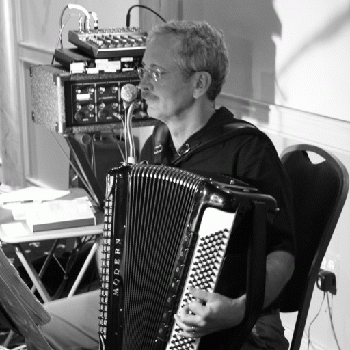
In 1998, I returned to my musical roots by buying a top-tier, handmade, professional Borsini accordion, made in the 1960s, specially designed by the world-famous Tony Dannon of Modern Accordion Studio, and equipped with an advanced MIDI system. This new technology allowed me to perform as a one-person band or in collaboration with a guitarist, without needing a drummer. My MIDI-equipped accordion is connected to three sound orchestrator modules: the Roland BK-7M Backing Module, the Ketron X4 Orchestra/Rhythm Module, and the Orla 600 XM Orchestrator Module.
Each module delivered an exceptional range of high-quality rhythms, enriched with full, dynamic accompaniments—drums, strings, layered vocal textures, and hundreds of professional-grade instrumental voices. I also bought the Ketron SD4 sound module, celebrated for its remarkably realistic digital instruments. Its trumpet voices, in particular, are astonishingly lifelike—so authentic that you might imagine jazz greats such as Louis Armstrong, Bobby Hackett, or Harry James performing live.
These powerful sound and rhythm modules allowed me to perform as a true one-person band, seamlessly blending bass lines, lush strings, bold horn sections, percussion, and vocal choruses. With my left hand, I could activate intricate rhythm patterns, creating a rich, full-bodied accompaniment. Meanwhile, my right hand brings the melody to life on the keyboard, with an impressive array of instruments at my fingertips—from grand and electric pianos to classic organs, saxophones, clarinets, flutes, vibraphones, guitars, mandolins, steel drums, violins, and more.
Each sound module was connected to its own foot pedal, giving me complete real-time control to layer and blend instruments effortlessly. With a single touch, I could combine voices—such as saxophone with organ, vibes with accordion, or trumpet with organ—creating a powerful, dynamic ensemble sound. The result was the richness and depth of a full band, all delivered by one musician.
Up until 2012, I performed both as a strolling accordionist and alongside Jim Stefan, blending solo artistry with collaborative energy. When Jim relocated in 2012, I embraced a new musical direction, choosing to perform exclusively as a strolling accordion player.
Castiglione Accordions
In 1997, I purchased a custom-built Borsini 44-key jazz accordion, crafted for Modern Accordion Studios, from John “Giovanni” Castiglione, owner of Castiglione Accordions in Sterling Heights, Michigan. Shortly thereafter, John mentioned he was searching for someone to build a website for his company, then the largest accordion distribution center in the United States and one of the largest in the world. I offered my services and went on to design, develop, and maintain the site, serving as the company’s webmaster until May of 2020.
The website eventually expanded to more than 50 pages, featuring hundreds of photographs that showcased the wide range of accordions, accessories, and related products available both online and in the Sterling Heights showroom. Under John’s leadership, and with my digital support, Castiglione Accordions became a trusted resource for musicians nationwide and worldwide, recognized for its extensive selection and knowledgeable service.
During this time, I also assisted several of John’s customers by demonstrating how to set up and operate MIDI systems for their accordions. Because configuring MIDI and mastering orchestral or rhythm modules can be complex, I worked closely with accordion players to integrate devices such as Ketron, Orla, and Roland BK-7M rhythm and sound modules—either at the store or, on occasion, in my home studio down in the basement. My guidance helped accordionists and keyboard players confidently expand their instruments into full performance.
Sadly, John passed away on May 26, 2020, marking the end of an era in the American accordion community. Following his passing, the remaining accordions and accessories were sold, with most of the inventory acquired by Liberty Bellows in Pennsylvania—ensuring that his legacy continues to serve and inspire accordionists across the country.
Recently
I recently joined a talented group of professional accordionists who meet monthly at Mangia Pizza (38413 Joy Rd, Westland, MI). They gather on the second Wednesday of each month from 6:00 to 8:30 p.m.